The Bellini College is shaping USF’s future

By Paul Guzzo, University Communications and Marketing
Lawrence Hall’s colleagues had a nickname for him during his early years working in
artificial intelligence at the University of South Florida.
Some friends called him a “mad scientist,” said the distinguished university professor
and associate dean of research innovation at USF’s Bellini College of Artificial Intelligence,
Cybersecurity and Computing.
Hall understands the label.
In the 1980s, using artificial intelligence in everyday life felt more like science
fiction than science fact. But today, the onetime “mad scientist” has earned a new
title: Pioneer.
Hall was among USF’s earliest AI researchers and is now one of the leaders of the
university’s recently established Bellini College, the first of its kind in Florida
and one of only a few in the nation. Its name was established last spring following
a record-setting $40 gift from Arnie and Lauren Bellini.
“Everybody’s using it, touching it,” Hall said of AI. “You probably have it on your
phone.”

The Behavioral AI Lab has artificial intelligence tools of eye-tracking technology
and facial expression sensor

A University of South Florida computer lab in the 1980s [Photo courtesy of USF Tampa
Library]
USF celebrates its 70th anniversary this year, marking Dec. 18, 1956, when state leaders
approved the university. Early adoption of AI is a key part of that history, and
the Bellini College is expected to shape every USF discipline as the university looks
toward its future.
“We can always think back into the past and think about how computing has changed
over time and how things have evolved,” said Michelle McAveety, a junior computer
engineering major with the Bellini College, now in its inaugural year. “But to be
on the cutting edge of it and to see AI emerging, to see what the future of our education
looks like and the future of our world of safety, our security, it’s very inspiring
to get to be a part of that story.”
Early days of computing and community
Hall wasn’t the first USF professor to research artificial intelligence. That distinction
goes to Kevin Boyer, who arrived in 1984 and has since moved on from USF. Hall was
hired two years later.
After earning his doctoral degree in computer science from Florida State University,
Hall’s advisor told him that he should start his career at USF.
“USF was an up-and-coming university, so I should take the job here. I thought that
would be in five years and be up and done. It took a little longer, but we are an
AAU university now.”
Technology in those early years was scarce and what existed was archaic by today’s
standards.
Before the world wide web was invented in 1989 and popularized in the early 1990s,
the internet looked and felt nothing like the modern web. Instead of clicking links
and browsing pages, people used a patchwork of text-based systems to which they had
to connect directly, typically by phone via modems.
So, checking email felt like it took “three days,” Hall said.
Today, AI learns from datasets that can range from thousands to millions of examples.
But during those slower online days, the data had to be manually entered into the
system.
“Maybe 200 examples at a time,” Hall said. “I came from a university where I had a
workstation on my desk and a workstation at USF, at that time, wasn’t possible.”
Learning about computers was mostly limited to the USF College of Engineering, and
the hardware was considered “dumb terminals,” screens and keyboards connected to a
shared central computer.
“Some younger faculty wanted to do research, and we sort of banded together and worked
with each other in a sense of backing up each other’s ideas,” Hall said. “We all moved
forward doing really good work and helping the university evolve.”
USF was also ahead of the times, one of a few universities to dedicate resources to
AI research.
“USF was putting an emphasis on AI, partly because it made us more unique” said Hall,
whose research focuses on teaching computers to learn from data sets, recognize patterns
and use AI to understand images. “Partly I think it was because we had a few good
people who were doing good work and other people said, ‘Well, we could come there
and do good AI work also.’”

Louise Stark at a USF computer in the late 1980s when she was one of the university’s
first students to research AI

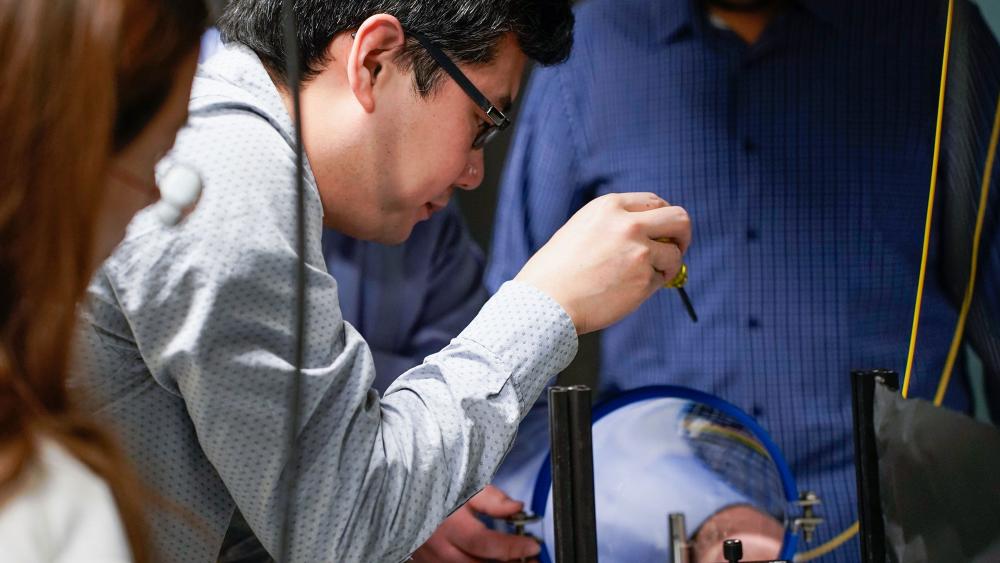
Duy Dao, assistant director of USF’s Security Operations and Cybersecurity Apprenticeship
Program, and his interns
A new college, CyberHerd, and the next generation of professionals
That pioneering work led to the launch of the Bellini College three decades later.
The college is charged with producing job-ready professionals in the fields of artificial
intelligence, cybersecurity and computing. Its strategic, interdisciplinary focus
is an important part of its mission. Faculty aim to work collaboratively across all
USF colleges to produce graduates who can leverage artificial intelligence to enhance
their work.
That second goal, perhaps more than the advancement of technology, shows how far USF
has come. In the early days, artificial intelligence researchers felt “secluded,”
Hall said.

USF is developing an AI-enabled smart trap that identifies disease-carrying mosquitoes,
such as those spreading malaria and dengue

George Spirou, professor of medical engineering, using a VR set paired with the software
he created to intricately explore neurons in the body
It’s what the Bellini College calls a “hub and spoke model.”
Disciplines at the center of a college, or a hub, concentrate on foundational research.
At USF, the hub is made up of computer science, cybersecurity, information technology
and artificial intelligence.
The spokes are specialized areas of study. To start, business, criminology and social
sciences will make up the spokes through classes offered through each subject’s respective
college.
Over time, that will grow to include all colleges, with Bellini College research being
geared toward how to benefit those disciplines.
The Bellini College’s success is expected to ripple across Tampa Bay by attracting
companies that will want to employ graduates, turning the area into what some are
already calling “Cyber Bay.”
“It’s going to be a nexus for artificial intelligence research as well as producing
people who can do cyber security,” Hall said. “We’re going to be producing a cadre
of graduates who can go on to help regional companies.”
About 3,000 students are currently enrolled in the Bellini College today and 5,000
are expected to by 2027.
Students like McAveety point out that the Bellini College is already attracting some
of the top students in the world. She serves as captain of USF’s CyberHerd team, which
enters collegiate cybersecurity competitions that challenge students to defend or
attack simulated computer systems – testing skills in real-world cyber scenarios.
They score points by rapidly identifying threats, prioritizing fixes and communicating
under pressure to protect or penetrate simulated systems.
In just its third year, CyberHerd typically finishes in the top three in competitions
and McAveety said the team is cognizant to remember that their road to success was
paved by pioneers such as Hall.
“I’ve always been so impressed by professors and their continued dedication to their
craft, their continued investment in research and continuing to give back to their
communities, taking their knowledge and inspiring the next generation,” she said.
“I hope to give back to either USF or the broader community in just a fraction of
the way that these wonderful people have.”
link