Supercomputing collab brings national lab experts to UH, expands student opportunities

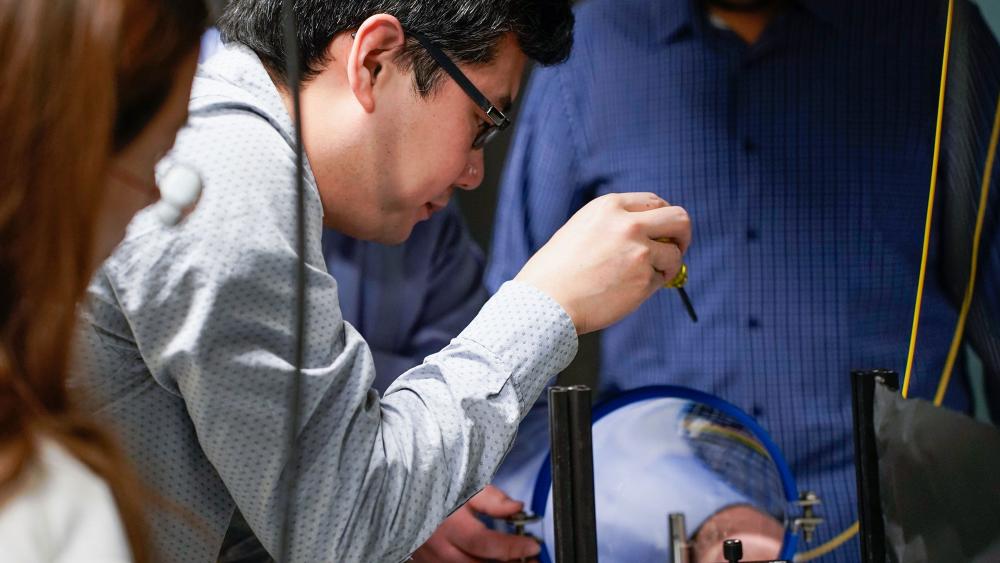
A team of researchers and engineers from the University of Hawaiʻi at Mānoa, Lawrence Berkeley National Laboratory and Lawrence Livermore National Laboratory spent two weeks at UH in May and June, training the next generation of computational scientists on cutting-edge supercomputing tools and energy applications and collaborating on energy research projects.

The visit was part of a Department of Energy-backed effort to support ambitious fundamental research in support of the Department of Energy’s Office of Science goals of advancing energy security of the U.S. It also marked an exciting opportunity to bring national supercomputing expertise to Hawaiʻi.
At the center of the collaboration are three leading scientific computing frameworks and libraries: PISALE, a versatile simulation platform used by researchers for modeling a wide variety of complex applications and physical phenomena; AMReX, a framework for solving complex 3D multiscale scientific problems; and MFEM, a software library for high performance multiphysics simulations on general unstructured grids.
“This collaboration is an incredible opportunity to bring world-class mathematics and computing experts to Hawaiʻi and empower our students to work on some of the biggest scientific challenges of our time,” said Alice Koniges, graduate faculty in the UH Mānoa Department of Information and Computer Sciences and project principal investigator. “Training the next generation right here at UH Mānoa ensures our students are not just participants, but leaders in the future of computational science.”

The National Energy Research Scientific Computing Center (NERSC) provided UH Mānoa and visiting New York University researchers and students access to Perlmutter, one of the world’s current top high-performance computers for the event. During the workshop, the next leap in computing, a new NERSC supercomputer launching in 2026, was announced by the Department of Energy and NERSC and also celebrated at the workshop. Sophisticated programming models and techniques that will be necessary for harnessing the power of this new computer were introduced to the students with hands-on exercises. This new flagship system will be built using cutting-edge technology such as the latest NVIDIA Vera-Rubin CPU–GPUs designed for advanced scientific and AI workloads.
Over the course of the visit, graduate students from UH Mānoa and collaborating institution New York University received specialized training in using these advanced systems and worked on problems related to energy development. One focus of the project is to build digital models/twins of complex environments needed for next generation energy production including tools that will help model geothermal energy, groundwater in Hawaiʻi, and design new materials for energy and computing technologies.
“This program has increased the preparedness of UH Mānoa’s students to use the best computing codes, increasing the scientific research footprint of the university,” said Neil Mehta, a NERSC performance engineer.
Kevin Gott, a NERSC performance engineer added, “Programs like these are vital in ensuring the next generation of scientists are prepared to use cutting edge, high-performance computing facilities.”
By bringing these resources to local students, the program expands research opportunities in the islands and connects Hawaiʻi to the national frontier of scientific discovery. The workshop also provided a collaborative environment for advancing next-generation energy solutions to help meet global energy needs, while reinforcing U.S. leadership in energy innovation.
—By Marc Arakaki
link