
Why brands should stand firm on their values despite the fear of backlash
NEW YORK — Brand values have experienced significant transformation in recent years. Diversity, equity and inclusion initiatives from marketers that were once a priority have moved to the back burner, with many brands retreating from such strategies amid a shifting — and increasingly tense — political landscape. Similarly, brands that once championed values like sustainability have fallen under fire for failing to deliver on their promises.
Consumers simultaneously have become more vocal in expressing their support or opposition for the stances brands rally behind. Still, it remains critical for brands to stand firm on their values for the sake of their business, even despite the fear of backlash, according to executives at an Advertising Week New York panel on Monday (Oct. 6).
“I think the brands that are very clear on their values and are clear on their audience and their consumers are the ones who ultimately are going to be able to see the growth,” said Erika Lewis, head of cultural partnerships at TikTok. “There’s a lot of fear, but sometimes you have to do it afraid, and when you do it afraid you may make a misstep, but it doesn’t mean that it’s the end — hopefully — of the world.”
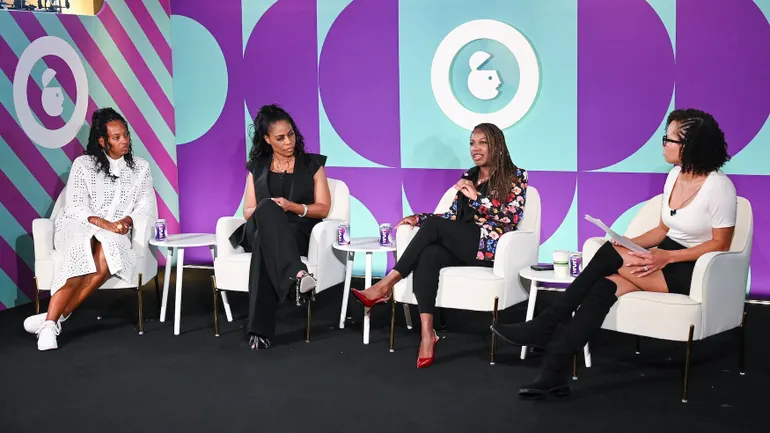
The panel, titled “Brand Values Must Be Unshakeable,” also included Shetellia Riley Irving, founder and CEO of A11Even Sports and Sheila Marmon, CEO and founder of multicultural media company Mirror Digital, and was moderated by God-is Rivera, chief strategy officer at Burrell Communications Group Worldwide. The talk addressed the importance of clear brand values for the sake of consumer loyalty, the value of inclusive marketing strategies and the future of such strategies in a fraught landscape.
Keeping brand values top-of-mind
Some brands have been unapologetic in their values for years, from Ben & Jerry’s, which dedicates a section of its website to highlighting its social mission, to Chick-fil-A, which bases its business on Biblical principles. While taking a firm position in today’s climate may feel high risk, brand values remain key to forming an authentic consumer relationship, explained Marmon.
“Brands mean something to the consumer,” said Marmon. “A brand you identify with or want to associate with says you feel says something about you, so understanding what that value is and knowing that it, as a consumer of that brand in some way, connects to who you are as part of your self-identification — that’s something brands have to keep top of mind as they say one thing or say another thing.”
Identifying those core values can also help brands develop a better understanding of their consumers and build a more effective marketing strategy, Lewis added. However, just as important as defining brand values is sticking to them. Earlier this year, Target announced the end of some of its diversity efforts, citing “the importance of staying in step with the evolving external landscape,” a move that led to ongoing boycotts from left-leaning consumers.
“You can’t deviate from who your core consumer is, you have to understand them, you have to talk to them, you have to engage with them,” Irving said on the importance of consistency.
The value of inclusivity
Opportunity lies in developing inclusive strategies. The fastest growing consumer market is diverse growth audiences, which represent $6.8 trillion in buying power and stand as the third largest global economy, according to Marmon.
“When you are talking to brands about what is going to drive growth, it’s really clear that they need to understand that America is a broad diaspora of inclusive individuals,” Marmon said. “Thinking about values that are inclusive, thinking about values that are clear, are going to be central to helping you drive growth for your brand across the spectrum.”
A handful of brands have recently doubled down on inclusivity, including Gap and E.l.f. Beauty. Under the leadership of CEO Tarang Amin, E.l.f. in July declared, “Inclusivity is not optional. It’s fundamental, and our entire business is based on that.” E.l.f. delivered its 26th consecutive quarter of net sales growth in its most recent earnings period.
“When you have leadership that understands what they’re trying to accomplish with their brand, with the business, I think they’re more likely to be able to put a stake in the ground on their values,” Marmon said of E.l.f.
Marketing strategies could also benefit from considering household dynamics, Irving explained, asserting that women are the “CEOs of their household” and are key to purchasing decisions. Women are directly or indirectly responsible for up to $17.4 trillion in consumer spending in the U.S., representing 85% of total spend, according to Capital One Shopping Research.
“How do you not talk to them? How do you not engage with them?” Irving said. “They are dictating what goes in and out of that households, and if brands don’t understand that, I feel sorry, because in five years they won’t exist.”
TikTok’s Lewis pointed to a recent example around the viral social media prank regarding the “Anthropologie rock,” a trend that began when one creator, followed by a stream of others, shared a video of her “unboxing” a rock that she claimed to have purchased on sale from the retail brand for $150, much to her boyfriend’s dismay. The marketer got in on the prank by setting up a table of fake Anthropologie rocks with price tags as high as $1,000.
“Their values are around creativity, their values are around women’s empowerment,” Lewis said. “It’s just kind of leaning in and understanding, like we hear you, we see you, this is actually a fun way for us to be aligned with what you have going with our values.”
Pushing past the fear and what’s to come
As political tensions endure, brand hesitation around expressing values is likely to remain, executives predict. To move forward, brands will need to demonstrate courage and an unwavering commitment to their target audiences, all of whom are quick to spot inauthenticity, Irving explained.
“There’s a lot of fear that exists in terms of standing up and saying, ‘This is who my consumer is.’ Given what’s happening politically, they either hide, or they go to the other side. And I think it’s going to be very tough for brands — it’s going to take brave souls, I like to call it, to really come in and say, ‘This is who we are. I’m unapologetic,’” Irving said.
For brands attempting to define their values, Lewis stressed the importance of first being self-assured in what those values are before taking them to the mainstream.
“I think the fear piece of it sometimes is just the brand not being confident in themselves,” she said. “It’s really about, what do we stand for. Ask your employees, they’re working on your brand every day, ask them ‘What do you stand for?’ and is there alignment? And then once you clearly understand that, then it’s, who are the consumers that will appreciate this, that are aligned with us, and how can we go deeper with them?”
One way of forming a deeper connection is tapping into niche subculture, Lewis said, pointing to TikTok’s popular #BookTok channel as an example of a key opportunity for brands to resonate with a specific cohort of consumers versus “trying to be something to everyone else.” In the future, the executive expects brands to become more focused in the way they talk to specific consumer groups, and the partners and creators they choose to represent those communities, versus a one-size-fits-all approach.
“I think this idea of being a brand for everyone, I think that’s where the fear comes in because it almost feels like it’s impossible in today’s world,” Lewis said. “On one hand that makes me kind of sad, but on the other hand, hopefully that means there will be more meaningful brand relationships with the communities that truly support them, and they support in return.”
To close the discussion, Burrell Communications’ Rivera challenged the panelists to offer one line of advice to brands looking to refine and showcase their brand values. First, brands should look internally for the unique value they hope to add to consumers’ lives, because their value and value proposition begins with how they present themselves, Marmon responded. Next — assuming they’ve honed in on who their consumer is — brands should seek expert help to help refine their strategy, Irving added.
“Once you do those two things, you have to let go,” Lewis said. “You have to let the experts, the creators, the consumers that are nowadays owning your brand and advocating for your brand, do what they do in a way that allows your brand to be amplified.”
link